Product · EIS Fitting
Not just fitted spectra — interpreted EIS results, in minutes, at scale.
Each fit ships with a written interpretation: the circuit class, what the parameters imply, and the places the fit isn't safe to trust. Across one spectrum or a full archive.
Walkthrough
- Step 01· Upload
Upload.
Upload your data, assign labels, and provide experimental context.
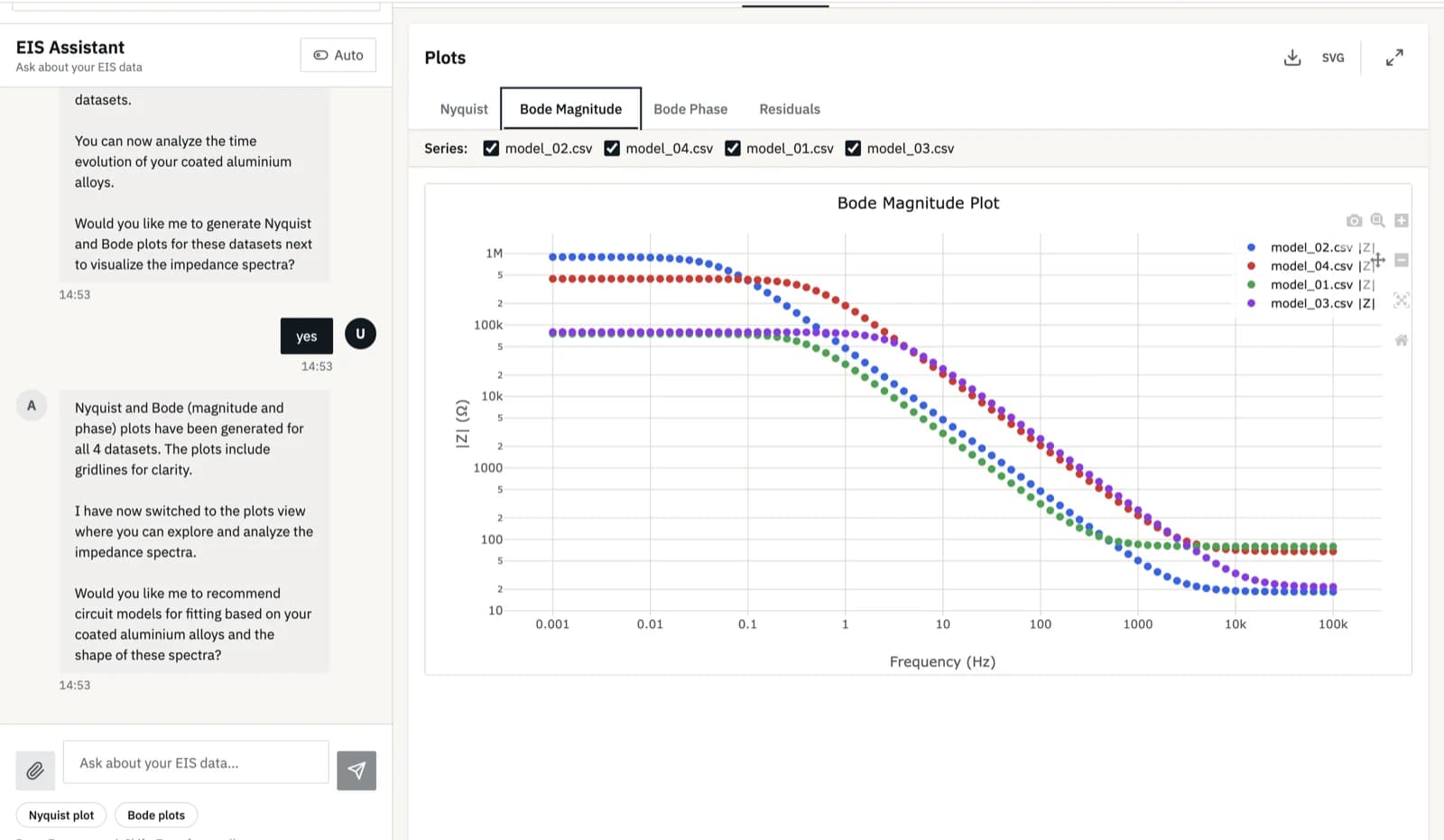
- Step 02· Visualize
Visualize.
Visualize your dataset in Bode or Nyquist representation.
- Step 03· Fit + interpret
Fit and interpret.
The assistant handles the fitting, identifies the most appropriate circuits, and discusses the possible interpretations with you.
- Step 04· Report and export
Report and export.
Generate high-quality figures via conversation with the assistant. The assistant then writes the report with figures and discussion.
§ 04 · Methodology
What the fit actually does — said plainly.
EIS Fitting is a propose–review loop wrapped around a non-linear least-squares fitter. The fitting algorithm class is named. The initial-guess strategy is named. The uncertainty estimator is named. Nothing here is opaque.
- 01Fitting algorithm class
- Non-linear least-squares with bounded parameters. Implementation is open to inspection; we do not run a fitter whose objective function we will not show you.
- 02Initial-guess strategy
- Spectrum-derived priors with bounded perturbation, not random restarts. We document why a given starting point was chosen and which parameters were locked during the first pass.
- 03Propose–review loop
- The assistant proposes a topology and parameter set. You see the proposal — and the residuals — before the fit is committed to your run history. Accept, refine, or reject.
- 04Residuals · parameter uncertainty
- Normalised residuals are reported alongside per-parameter uncertainty. A high-χ² fit with well-bounded parameters and a high-uncertainty fit with great-looking residuals are distinguished, not collapsed.
Pricing
- Free credits
- Free credits awarded at signup.
- What a credit buys
- What a credit buys: one full fit run.
- Expiry
- Credits never expire.
- Renewal
- No auto-renewal trap.
- Exports available
- Account portable
- Data deletable on request
- What's stored vs ephemeral is documented per object
Your data is account-tied, not used to train models, deletable on request. See /data-handling
Related
- See it run on real data — case study
- Learn the theory — course on EIS

Honest beta
The propose step's circuit-class library is being expanded; some specialty cells may fall back to manual circuit entry.
The fitting algorithm class, residuals, and per-parameter uncertainty are stable.
Free credits are sufficient to evaluate the workflow end-to-end on a representative spectrum.