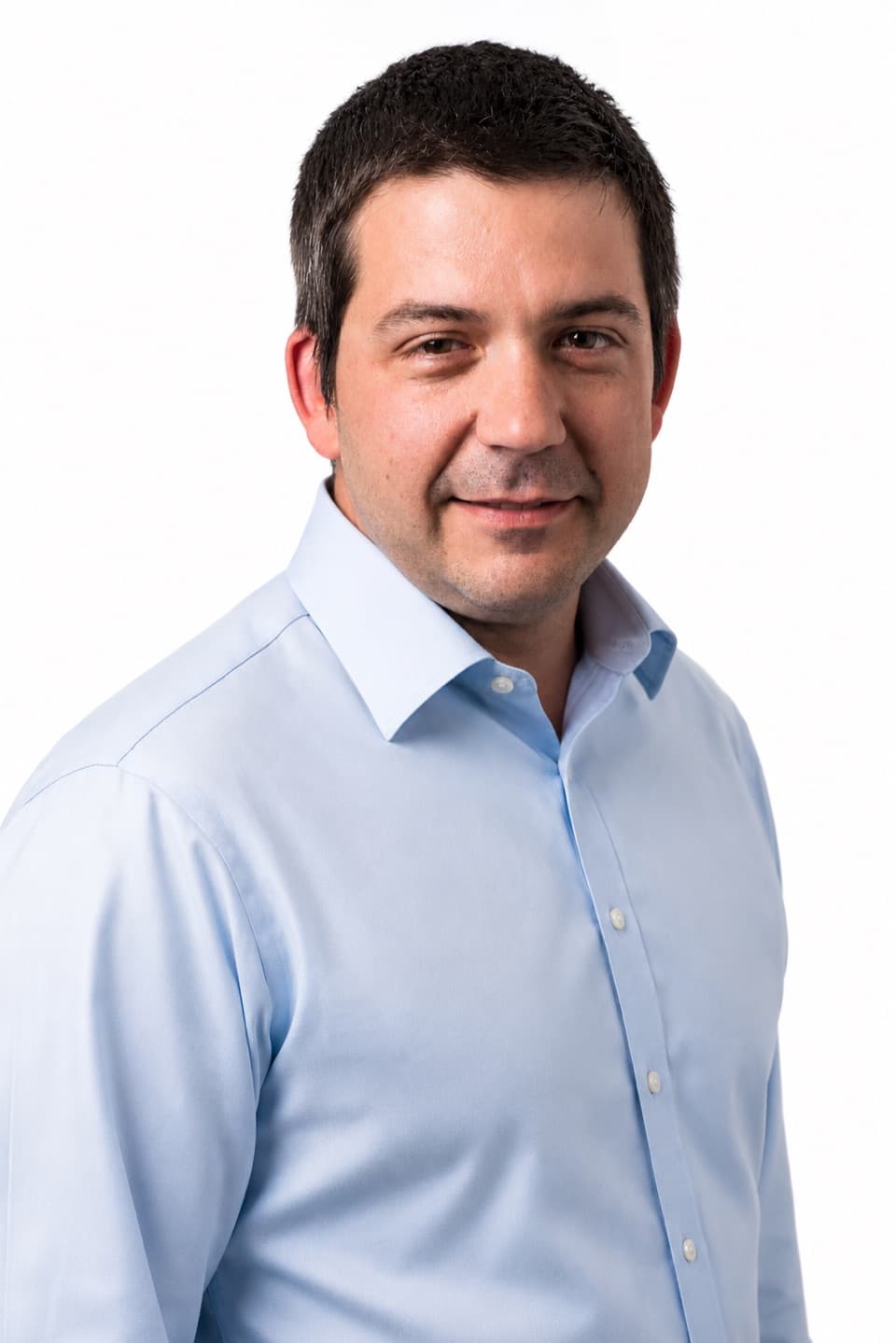
Michele Curioni, PhD
Corrosion scientist · 20+ years applied research · Founder, CorroZone.
Twenty years of corrosion science — now applied to your data.
I have worked for many years on the methods that make corrosion measurable: electrochemical impedance spectroscopy, electrochemical noise, real-time hydrogen measurement, and optical imaging, all coupled with more traditional technological methods. My research career has been built around a central question: what can we read from a signal, and where does conventional interpretation stop being safe? More recently, I have developed machine-learning and large-language-model approaches to interpret corrosion data for organic coatings, asking the same question at the next layer up: what can a model read from these signals, and where do its conclusions require scientific judgement?
More than fifty of my papers focus on how surface treatments and organic coatings determine the long-term corrosion behaviour of components in aerospace and industrial environments. The thread across my work is the link between process parameters during surface treatment and the in-service durability of the treated component, evaluated by advanced corrosion testing methods.
I also have led and contributed to research on corrosion in nuclear power systems, stress corrosion cracking, materials behaviour in high-temperature water, magnesium corrosion for both lightweight structural and biomedical-implant applications. These projects, conducted with industrial partners and academic collaborators worldwide, share a methodological discipline: testing protocols designed to make accelerated laboratory data say something defensible about service-life behaviour.
In 2023 I founded CorroZone to apply the same methodological discipline to AI tools for corrosion practice — first as online education for researchers and technical staff, then as tailored corporate workflows that bring AI to legacy laboratory data, accelerate analysis cycles, and build domain-specific tools that the academic literature does not yet offer. The work at CorroZone is continuous with the research: methodology comes first, data is curated and labelled with scientific care, and every claim has a signature.
Since 2022 I have served as Associate Editor of Corrosion Engineering, Science and Technology — one of the field's longest-running peer-reviewed journals — where I handle submissions, select reviewers, and oversee peer-review decisions across the breadth of corrosion science. The editorial role is continuous with the rest of the work: it is about making sure claims are checked, methodology is interrogated, and the published record stays defensible.
Selected publications
Selected publications from over 150 peer-reviewed papers (h-index 43, i10-index 102, 5,719 citations as of 2026). Full record on Google Scholar →.
- 2025in press
Exploring the use of large language models for EIS: A feasibility study on organic coatings for corrosion protection
V. Bongiorno, N. Hijnen, X. Zhou, M. Curioni
Corrosion Engineering, Science and Technology (in press)
- 2023
Mitigation effects of over-aging (T73) induced intergranular corrosion on stress corrosion cracking of AA7075 aluminium alloy and behaviours of η-phase grain-boundary precipitates
Y. Xiong, J. D. Robson, Z. Cao, Y. Deng, Y. Yao, X. Zhong, A. Bendo, L. Jinlong, … M. Curioni
Corrosion Science 225, 111570
10.1016/j.corsci.2023.111570 - 2023
Effects of heat treatments on the microstructure and localised corrosion behaviours of AA7075 aluminium alloy
Y. Xiong, J. D. Robson, Y. Yao, X. Zhong, F. Guarracino, A. Bendo, Z. Jin, … M. Curioni
Corrosion Science 221, 111361
10.1016/j.corsci.2023.111361 - 2022
Exploring the use of machine learning for interpreting electrochemical impedance spectroscopy data: evaluation of the training dataset size
V. Bongiorno, S. Gibbon, E. Michailidou, M. Curioni
Corrosion Science 198, 110119
10.1016/j.corsci.2022.110119 - 2020
The effect of exposure conditions on performance evaluation of post-treated anodic oxides on an aerospace aluminium alloy: comparison between salt spray and immersion testing
B. J. Usman, F. Scenini, M. Curioni
Surface and Coatings Technology 399, 126157
10.1016/j.surfcoat.2020.126157 - 2018
Complete long-term corrosion protection with chemical vapor deposited graphene
F. Yu, L. Camilli, T. Wang, D. M. A. Mackenzie, M. Curioni, R. Akid, P. Bøggild
Carbon 132, 78–84
10.1016/j.carbon.2018.02.038 - 2015
Correlation between electrochemical impedance measurements and corrosion rate of magnesium investigated by real-time hydrogen measurement and optical imaging
M. Curioni, F. Scenini, T. Monetta, F. Bellucci
Electrochimica Acta 166, 372–384
10.1016/j.electacta.2015.03.050 - 2014
The behaviour of magnesium during free corrosion and potentiodynamic polarization investigated by real-time hydrogen measurement and optical imaging
M. Curioni
Electrochimica Acta 120, 284–292
10.1016/j.electacta.2013.12.109 - 2010
The behaviour of second-phase particles during anodizing of aluminium alloys
M. Saenz de Miera, M. Curioni, P. Skeldon, G. E. Thompson
Corrosion Science 52(7), 2489–2497
10.1016/j.corsci.2010.03.018 - 2009
Role of tartaric acid on the anodizing and corrosion behavior of AA 2024 T3 aluminium alloy
M. Curioni, P. Skeldon, E. Koroleva, G. E. Thompson, J. Ferguson
Journal of the Electrochemical Society 156(4), C147–C153
10.1149/1.3076146
Methodology lineage
The CorroZone tooling does not invent methodology. Every approach we offer — from EIS analysis to AI-assisted image interpretation to bespoke workflow design — traces back to the published record above. If you want to see how a specific method becomes a product, the methodology pages walk through it; if you want to evaluate the flagship application, the EIS Fitting page shows the methodology operationalised.